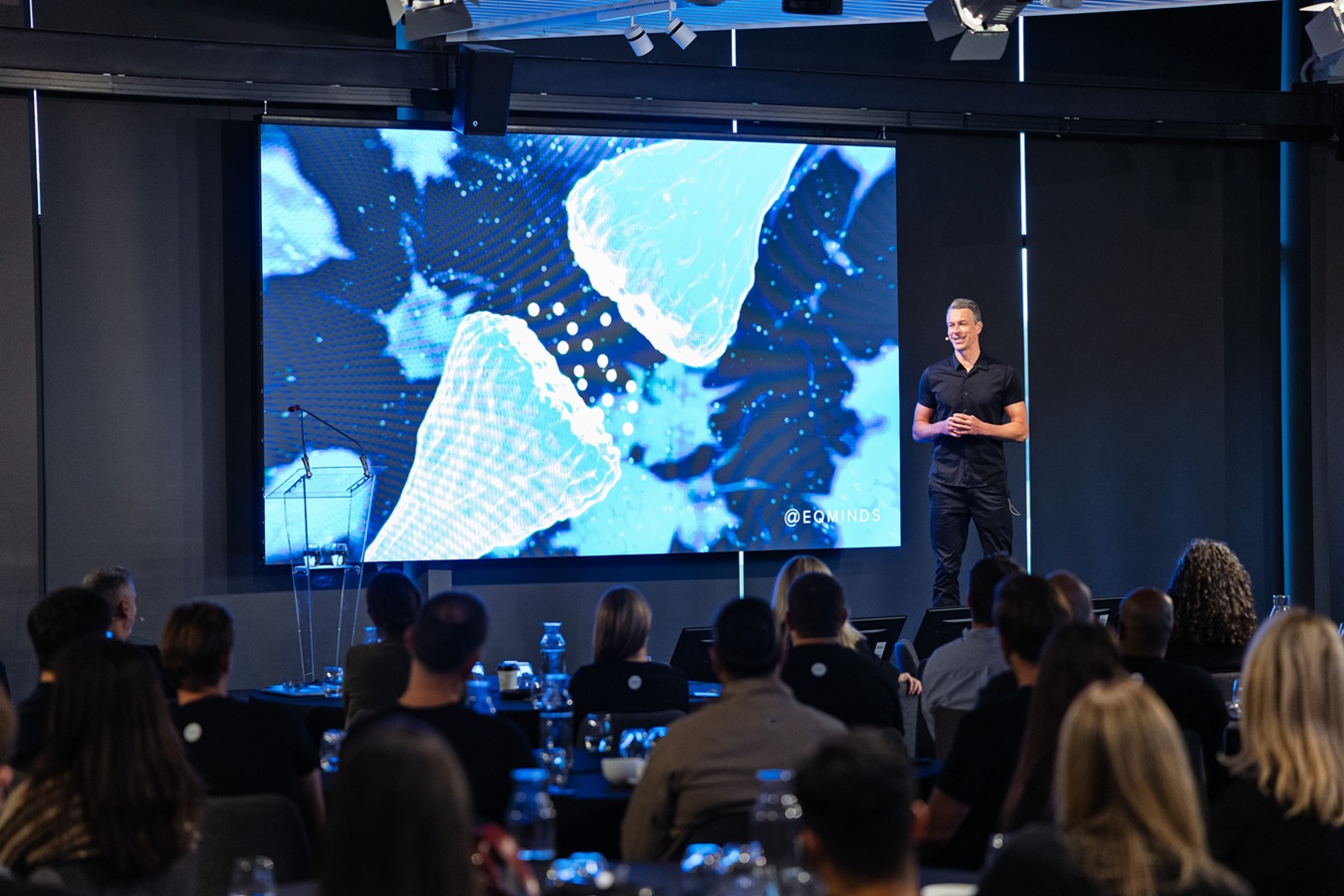
When Jay Pottenger steps onto the APP2026 stage, he won’t be offering lofty theories or abstract neuroscience. He’ll be speaking directly to the reality of community pharmacy — the relentless pace, the emotional load, the digital overwhelm — and the pressure to be everything to everyone.
And he’ll be doing it with a rare combination of scientific rigour, personal experience and some practical tools which fit into what can be the chaos of real life.
Jay, who has a postgraduate in mental health and neuroscience, and his wife, Chelsea, a psychology postgraduate, run a firm called EQ MINDS.
Together they have built a reputation for translating complex neuroscience and mental health research into simple, sustainable habits which can help people perform at their best without burning out.
Jay’s message at APP2026 will be particularly timely for a profession which has weathered years of workforce shortages, COVID-19, rising patient expectations, and expanding scopes of practice.
If you’re stressed, you tend to make sure everyone around you feels stressed as well, but the reverse is also true. Positivity spreads.
Jay Pottenger
But the story behind Jay’s work — and the reason he resonates so deeply with audiences — begins long before EQ MINDS.
Life-changing injury
More than a decade ago, Jay was living a very different life. After representing Australia in schoolboys basketball and playing semi-professionally, he transitioned into corporate finance, spending 15 years in leadership roles at major institutions.
He was driven, disciplined and thriving — until a severe back injury stopped everything.
“I blew out my back really badly,” he says. “Two herniated discs. I didn’t eat at a table for two years of my life. I had surgeries, saw every specialist you can imagine, and nothing worked.”
The turning point came when he was accepted into a clinical trial at Neuroscience Australia. Instead of more procedures, the trial focused on rewiring his pain pathways through mindfulness-based neuroplasticity techniques.
“They saved my life,” he says. “It completely changed my trajectory.”
The experience sparked a deep fascination with the brain — how it adapts, how it heals and how much control we have over our own mental and physical performance. It also planted the seed for what would eventually become his postgraduate study in mental health and neuroscience.
A family story
In a second turning point for their family, Chelsea experienced severe postnatal depression following the birth of their daughter. Her recovery — and the tools she used to rebuild her wellbeing — became another defining chapter for the Pottengers.
“Chelsea’s experience drove my interest in mental health,” he says. “That’s why I combined mental health and neuroscience in my post-grad.”
Chelsea’s journey is now widely known through her book The Mindful High Performer and her work as a Mental Health Ambassador for The Gidget Foundation Australia. Together, the Pottengers have shaped EQ MINDS into a trusted wellbeing education platform used by organisations across Australia.
But Jay’s focus — and what he’ll bring to APP2026 — is distinctly his own.
Three pillars
Jay’s conference session is built around three pillars: psychological detachment, emotional contagion and sleep. Each is grounded in neuroscience, and each speaks directly to the pressures pharmacists face daily.
Psychological detachment: the missing ingredient in recovery
In a world where phones have become extensions of our hands, switching off has become almost impossible. For pharmacists — who often field after-hours messages, juggle digital scripts and manage constant interruptions — the line between work and rest has blurred to the point of invisibility.
“Lack of psychological detachment is one of the leading indicators of burnout,” Jay says.
Pointing at his phone during our interview Jay says, “These little devices are incredible, but they make it very hard to switch off”.
His APP session will explore how constant connectivity affects the brain, why micro-breaks matter and how small, simple habits can help restore the mental separation needed for genuine recovery.
Emotional contagion: how stress spreads through teams
The second part of his presentation focuses on emotional contagion — the phenomenon where stress, frustration or negativity spreads from one person to another.
“If you’re stressed, you tend to make sure everyone around you feels stressed as well,” he says. “But the reverse is also true. Positivity spreads.”
For pharmacists leading teams, supporting trainees or managing difficult patient interactions, this concept is particularly relevant. Jay will introduce mindfulness-based strategies which can help people regulate their emotions, interrupt reactive patterns and create calmer, more resilient workplaces.
Sleep: the ultimate performance enhancer
The final pillar is sleep — a topic Jay describes as, “the greatest performance enhancer known to man”.
Drawing on the work of sleep scientist Dr Matthew Walker, he explains how poor sleep affects emotional regulation, decision-making and cognitive performance.
“When you don’t sleep, the connectivity in your brain basically turns off,” he says. “You become more reactive, more irritable, less focused. It affects how you treat people, how you parent, how you work.”
He’ll share practical strategies for improving sleep quality, including one of the simplest — and hardest — habits of all: getting off screens before bed.
The digital brain problem
One of the most compelling parts of Jay’s message is his explanation of how digital behaviour is reshaping our brains.
Short-form content, he says, is weakening the anterior cingulate cortex — the part of the brain responsible for emotional regulation and resilience.
“We’re training our brain to only focus on short-lived things,” he explains. “People can’t even watch movies anymore. They sit on the couch and pull out their phone.”
The good news? The brain can be strengthened again — but only through doing hard things.
“We like to clear the path for ourselves and our kids, but that robs us of building self-efficacy,” he says. “Struggle is how resilience forms.”
For pharmacists navigating constant digital demands, this message lands with particular force.
Practical tools
What sets Jay apart — and what will make his APP2026 session so valuable — is his commitment to practicality.
“We sat through thousands of presentations in corporate,” he says. “You hear these amazing stories and theories, and you think, ‘This is awesome — but what do I do with it?’”
His goal is to bridge the gap between theory and action.
“It doesn’t mean it’s easy, but it has to be simple. If it’s not simple, people won’t do it.”
This philosophy underpins everything from his teaching style to the tools EQ MINDS creates, including The Mindful Journal, a prompted gratitude journal designed to help people shift their mindset in small, sustainable ways.
Practical hope
Community pharmacy has always been a highpressure environment, but the past few years have pushed the profession to its limits. Workforce shortages, expanded clinical roles and the emotional demands of frontline care have left many pharmacists exhausted.
Jay’s message — grounded in science, shaped by personal experience and delivered with warmth and clarity — offers something rare: practical hope.
He won’t be asking pharmacists and other audience members to overhaul their lives. He’ll be showing them how small, consistent habits can compound over time, strengthening their resilience, sharpening their focus and protecting their wellbeing.
“Habits compound — just like interest,” he says. “If we can help people make a few small changes, the outcomes can be really positive.”
What matters
Whether you’re a pharmacy owner managing a team, a frontline pharmacist juggling competing demands or a student entering the profession, Jay’s APP2026 session promises to be grounding, energising and deeply relevant.
It’s not about doing more. It’s about doing what matters — with clarity, presence and a brain set up to thrive.